The name is a small lie. A modern rubber duck is almost never made of rubber, and whether it is safe depends far less on the material’s reputation than on who the duck is actually for. A duck handed to a toddler in a bathtub and a duck clipped to a Jeep mirror are held to very different legal standards, even when they come off the same mold. If you are ordering custom ducks in bulk, the useful questions are what the toy is made of, which rules attach to it, and what to ask a supplier to prove. Here is how those three pieces fit together.
What a rubber duck is actually made of
Nearly all custom ducks are molded from polyvinyl chloride, or PVC, which on its own is a hard, brittle plastic. What makes a duck squeezable is a plasticizer, an additive that wedges between the polymer chains and lets them slide, and the choice of plasticizer is the whole safety story. For decades the standard softeners were phthalates, which are cheap and effective but have been linked to hormone disruption and reproductive harm, which is why regulators moved against them in children’s products. Today reputable manufacturers reach for phthalate-free alternatives instead, commonly DINCH, terephthalates such as DOTP, citrates, and adipates, which deliver similar flexibility without the restricted compounds. A smaller share of ducks are made from silicone or natural rubber for buyers who want to avoid PVC entirely, though those cost more and behave differently in the mold, holding finer detail in silicone but softening less predictably in natural rubber. When a supplier calls a duck “phthalate-free,” they are really telling you which plasticizer family they used, and that claim is worth getting in writing.
The rules that apply if it is a toy
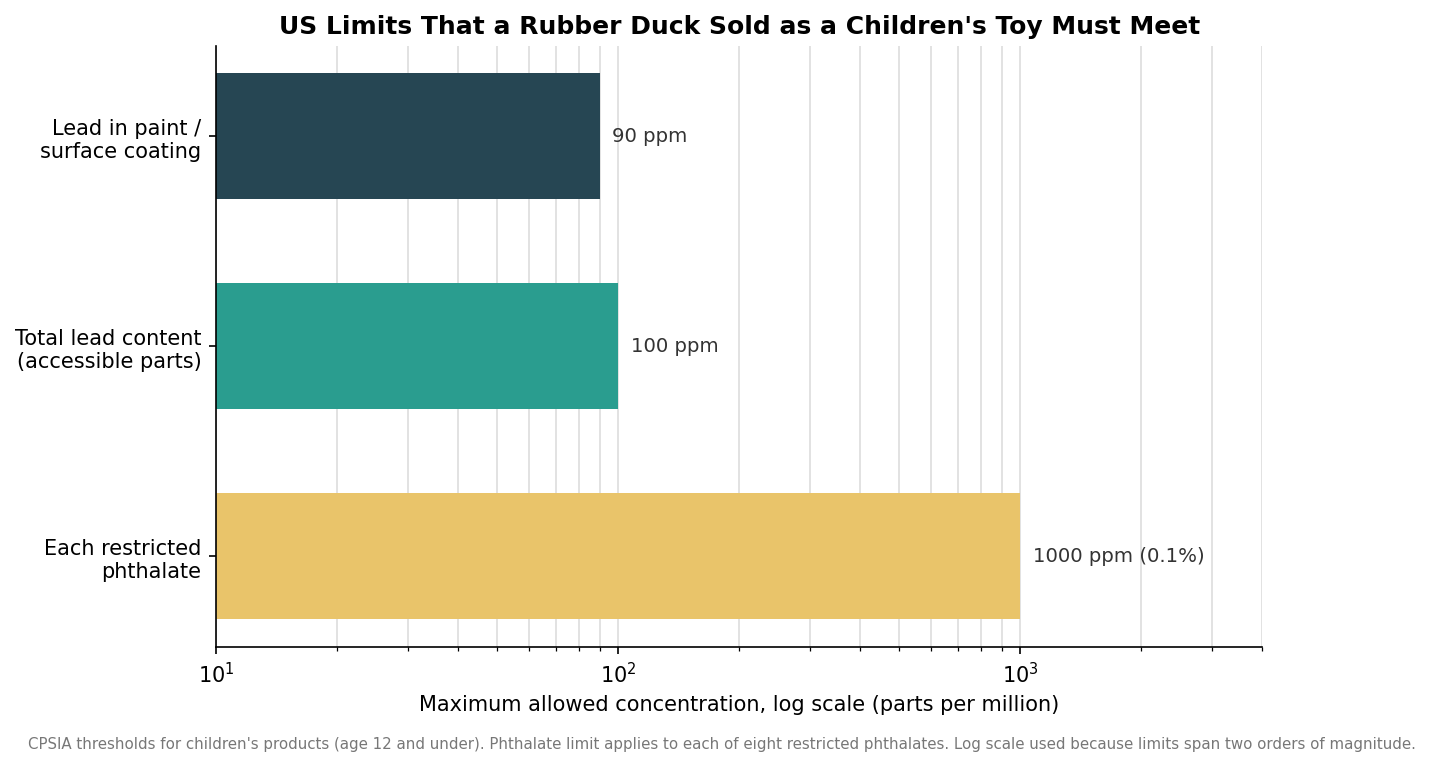
Once a duck is designed, manufactured, or marketed as a plaything for children under 14, US law treats it as a toy, and a stack of requirements switches on. The Consumer Product Safety Improvement Act caps total lead at 100 parts per million in accessible parts and lead in any paint or surface coating at 90 parts per million. It also permanently restricts eight named phthalates, DEHP, DBP, BBP, DINP, DIBP, DPENP, DHEXP, and DCHP, to no more than 0.1 percent each in the plasticized components a child can reach.
On top of the chemical limits sits ASTM F963, the federal toy safety standard. The current version, ASTM F963-23, was published in October 2023 and applies to toys manufactured on or after April 20, 2024. It goes well beyond chemistry to cover small parts and choking hazards, sound levels for squeakers, sharp points and edges, and labeling. Compliance is not a matter of a supplier’s word: a children’s product has to be tested by a CPSC-accepted third-party laboratory, and the importer or manufacturer then issues a Children’s Product Certificate documenting the passing results. A permanent tracking label on the product and packaging closes the loop so a specific batch can be traced later if a problem surfaces after it ships.
Who the duck is for changes everything
This is where custom orders get interesting, because the same duck can sit in two entirely different regulatory buckets. A duck sold as a bath toy or a party favor for kids is a children’s product and carries the full weight above. A duck produced strictly as an adult promotional novelty, a trade-show giveaway, or a Jeep-ducking gift that is genuinely not intended for or marketed to children, is not a children’s product and does not trigger the toy-specific testing regime.
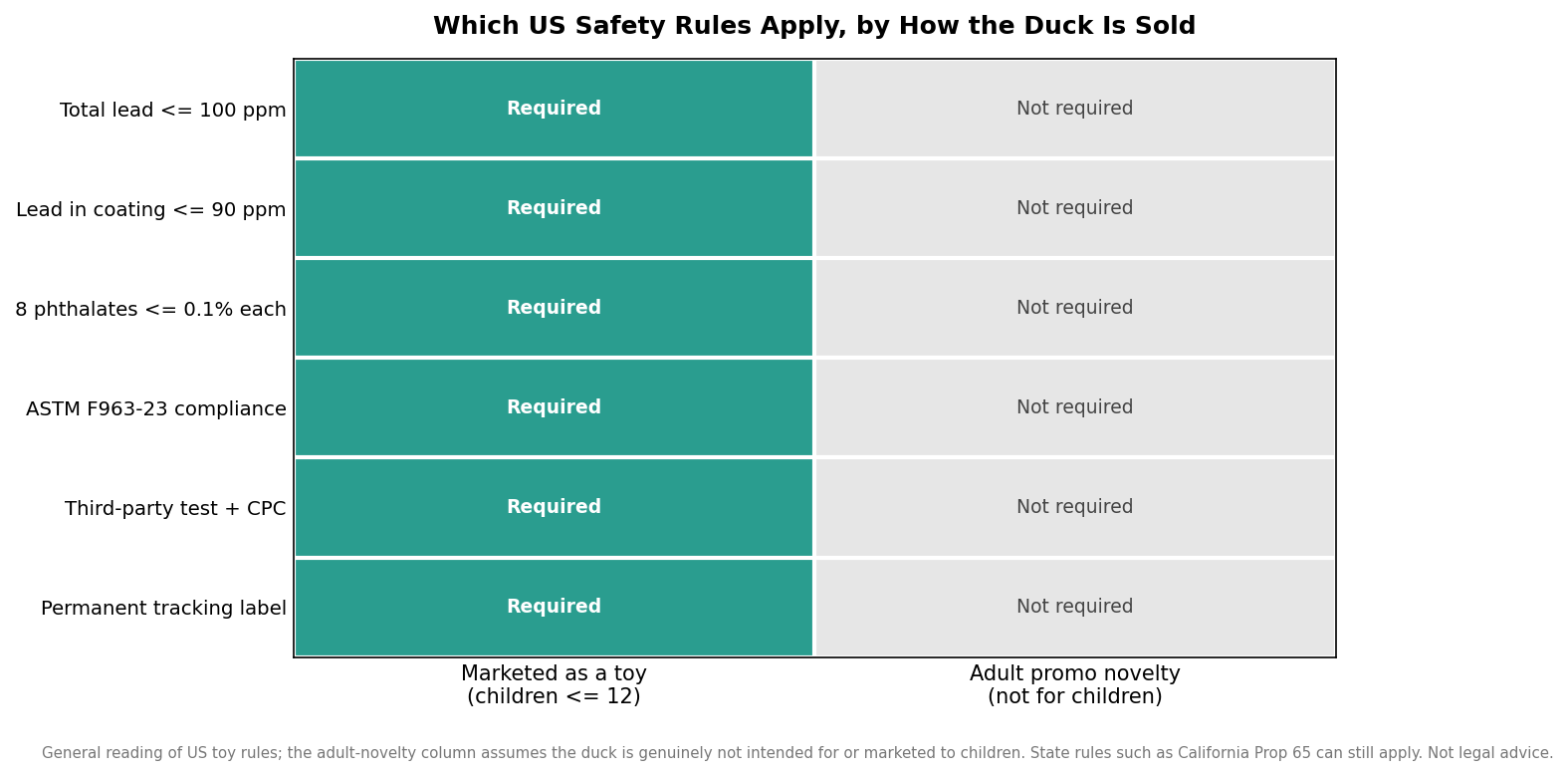
The catch is that intent is judged by how the product is designed, packaged, and advertised, not by a disclaimer buried on a hangtag. A duck in bright primary colors, sized for small hands, and shown in bath imagery will be read as a toy no matter what the fine print says. If you are ordering novelty ducks for an adult audience, keep the marketing and packaging consistent with that intent, and if there is any real chance children will use them, order to the children’s standard from the start rather than betting on the label. State rules can also apply on their own track; California’s Proposition 65, for example, can require warnings regardless of the federal toy question.
What to ask a supplier before you order
A safe order comes down to documentation, not promises. If the ducks are for children, ask for the Children’s Product Certificate and the underlying third-party test report against ASTM F963-23, and confirm the total lead, coating lead, and phthalate results fall under the limits above. For sale into Europe, the equivalent framework is the EN71 series, with EN71-1 covering mechanical and physical properties, EN71-2 flammability, and EN71-3 the migration of certain elements, paired with CE marking. Regardless of destination, ask which plasticizer the factory uses and get the phthalate-free claim specified by name. It is also worth confirming the duck has a properly sealed or drainable body, since the same squeaker hole that makes a duck squeak is the path water takes inside, where it can sit and grow mildew, a durability issue distinct from chemical safety but one buyers feel just as keenly. None of this requires you to become a compliance expert. It requires you to ask for the certificate, read the numbers, and match the product you order to the people who will actually hold it.