If you have parked near a trailhead or a mall in the last few years, you have probably seen a little rubber duck perched on a Jeep dashboard. It looks like a small in-joke, but “Jeep ducking” has grown into one of the largest grassroots gifting habits in the car world, and it runs entirely on cheap rubber ducks that strangers leave for one another. For a business, a club, or a dealership, that makes a custom-printed duck an unusually effective calling card. This guide covers where the trend came from, the etiquette that keeps it fun, and how to spec and order ducks that fit the culture instead of fighting it.
Where “duck duck jeep” came from
The tradition started in 2020 with Allison Parliament, a Canadian then living in Alabama. During the early pandemic she bought a bag of rubber ducks and, after a rough day, left one on a stranger’s Jeep with a note that simply said “nice Jeep.” The owner asked her to share it online, and the idea spread fast. By 2022 the Jeep-ducking Facebook groups had swelled to roughly half a million members, and by 2023 a duck on the dash had become a common sight at Jeep meets and parking lots alike. Parliament, affectionately called the “Mother Ducker” by the community, passed away in June 2024, and the tradition has since taken on a memorial dimension for many participants. The point of the origin story for a buyer is simple: this is a kindness ritual, not an advertising channel, and ducks that respect that spirit travel much further.
The unwritten rules that keep it fun
Ducking has a light etiquette that regulars take seriously. You duck other people’s Jeeps, not your own — self-ducking is considered bad form because it misses the whole point of a surprise gift from a stranger. Most people tuck the duck by a door handle or wiper so it is found but not blown off on the highway, and many tag it with a small “you’ve been ducked” card. Photos get shared under the #DuckDuckJeep hashtag, which is where a lot of the community’s momentum lives. A custom duck earns goodwill when it feels like a gift first and a logo second; a duck that reads like a flyer glued to a windshield tends to get tossed. That distinction should shape every decision you make about artwork, tags, and quantity.
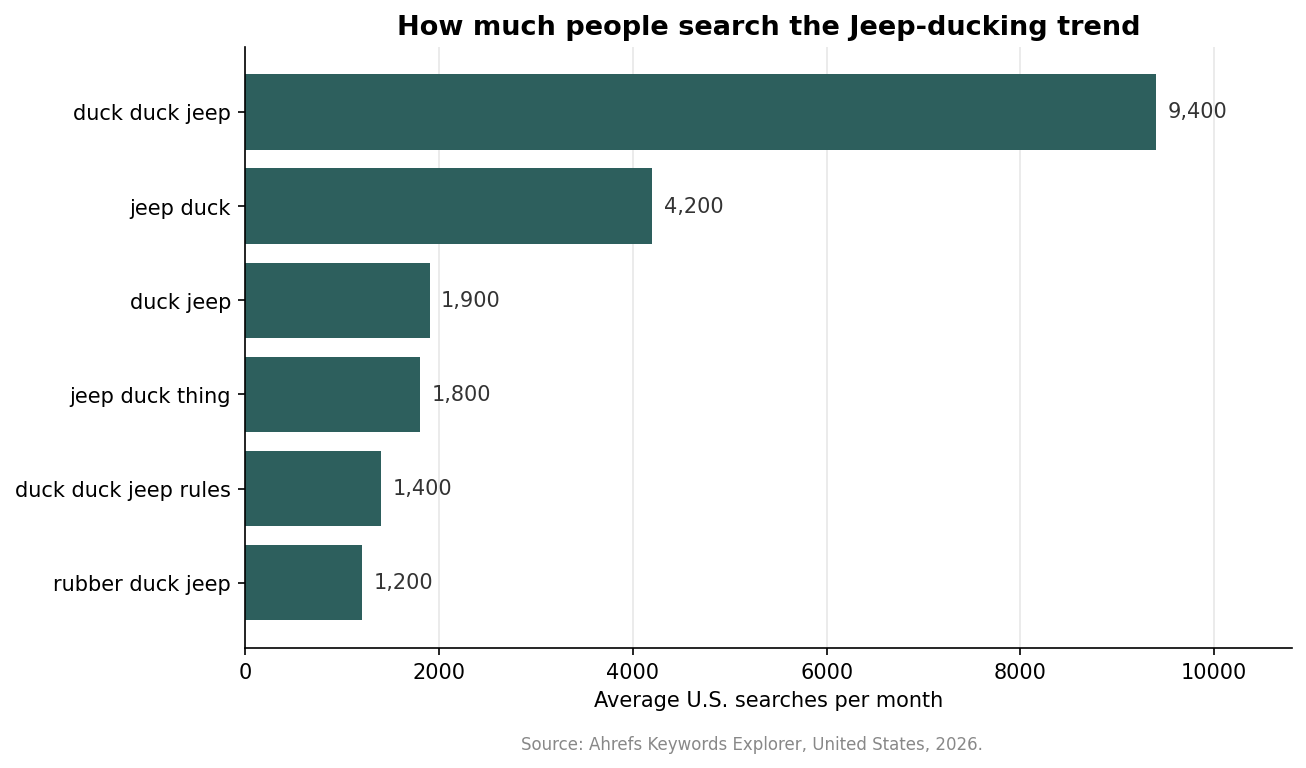
What actually makes a good Jeep duck
The workhorse of the whole trend is the standard two-inch rubber duck. It is small enough to sit unobtrusively on a dash or door handle, cheap enough to give away by the hundreds, and large enough to carry a readable one- or two-color print. Larger three- and four-inch ducks and tiny one-inch “mini” ducks both have a place, but the two-inch is the size the community is built around, and it is what most people expect to find. Because these ducks spend their lives on a sun-baked dashboard rather than in a bathtub, buoyancy barely matters, while UV and heat resistance do: a duck printed with durable ink on quality PVC keeps its color far longer than a bargain novelty duck that fades to a pale yellow in a season. If you want the artwork to survive, ask about the print method — pad printing and screen printing hold up well on the curved body, while cheap stickers peel in the heat.
Ordering custom ducks in bulk
There are two broad ways to get a branded duck. Printing your logo on a stock yellow duck is fast, inexpensive, and the right call for the vast majority of ducking programs. Commissioning a fully custom-molded duck — a new body shape or color — is a much bigger commitment, with tooling cost and extra production time on top. For most buyers the printed stock duck wins on every practical measure. At Customized Rubber Ducks the minimum order for printed ducks is 12, and the cost per duck falls as the run grows. Add-ons matter too: a “you’ve been ducked” hang tag, a QR code that points to your website or a community group, and polybagging all add a little cost but a lot of polish. Standard production for a printed order ships in about 2 weeks after you approve your free mockup, longer if you are commissioning tags or matching a specific Pantone color, so order well ahead of an event.
Who orders them, and why it works
The strongest programs come from businesses that already sit near the Jeep community. Dealerships hand ducks to buyers and leave them at meets; off-road and accessory shops slip them into orders; coffee stands, breweries, and local events use them as tiny, memorable giveaways. A QR-coded duck turns a roadside act of kindness into a soft introduction to your brand, and because the recipient chose to pick it up, the impression starts positive. The selection logic is straightforward: if your goal is pure community goodwill, keep the branding subtle and the tag warm; if you are running a measurable campaign, add a QR code and a short landing page so you can see what the ducks drive. Match the quantity to the plan — a single event might need 250, while an ongoing dealership program can run to the thousands. Get the size, the print durability, and the tag right, and a two-inch duck does something most promotional products never manage: it makes a stranger smile before they ever see your name.