Category: Uncategorized

  • How to Order Rubber Ducks for a Duck Race Fundraiser

    How to Order Rubber Ducks for a Duck Race Fundraiser

    A duck race fundraiser looks simple from the riverbank: hundreds of identical rubber ducks tumble down a stretch of water, and the first to cross the line wins its adopter a prize. Underneath that is a small logistics problem, and most of it comes down to which ducks you order and how many. Get the ducks right and the event mostly runs itself. Get them wrong — ducks that tip over, numbers that smear, or a count that does not match your fundraising goal — and you spend race day improvising. This guide walks through how to specify and order the ducks so the fundraiser holds together.

    How a duck race fundraiser works

    Supporters “adopt” a numbered duck for a set donation, and each duck carries a number that ties it back to the person who adopted it. On event day every duck goes into the water at once and the current carries them to a finish line; the earliest finishers win. Because the whole thing depends on one duck being distinguishable from the next only by its number, you need two things from your order: enough physical, consecutively numbered ducks to cover your adoption target, and a reliable way to link each number to an adopter. Everything else is a variation on those two requirements.

    Racing ducks versus bath ducks

    The single most important spec is that the ducks are built to race. A weighted racing duck — roughly 2.75 inches across with a weighted base — sits low and upright in the water, which keeps it buoyant, stops it from flipping, and reduces how much the wind pushes it around. That matters because a fair race depends on every duck behaving the same way. Standard bath or promotional ducks, usually two to three inches and hollow, ride higher, catch more wind, and are far more likely to tip or snag, which turns a race into a coin toss and invites complaints. Whatever you choose, order every racing duck identical: same mold, same size, same weighting. The only thing that should distinguish one duck from another is the number on the bottom.

    How many ducks to order

    Scale the order to your event, not your ambition. Small first-year races typically run a few hundred ducks; established community derbies run several thousand; the largest on record floated around 250,000. The practical rule is to order at least as many numbered ducks as the adoptions you expect to sell, then add a small spare margin — on the order of 5 to 10 percent — to cover ducks lost downstream, damaged in handling, or held back as samples. If you plan to reuse the ducks for future races, order the sturdier weighted style and collect them with nets immediately after the finish, which is standard practice both for reuse and for keeping plastic out of the waterway.

    Numbering and adopter tracking

    Ask the supplier for ducks that are consecutively numbered on the underside, printed or stamped durably enough to survive the water. Many race suppliers include a tagging kit that links each duck’s number to its adopter, but even a simple master spreadsheet works as long as every number is unique and legible. The failure mode to avoid is duplicate numbers across two batches; if you top up an order later, confirm the new ducks continue the sequence rather than restarting at one. Keep the adopter list backed up in more than one place, because the number on the winning duck is worthless if you cannot match it to a name.

    Budget and lead time

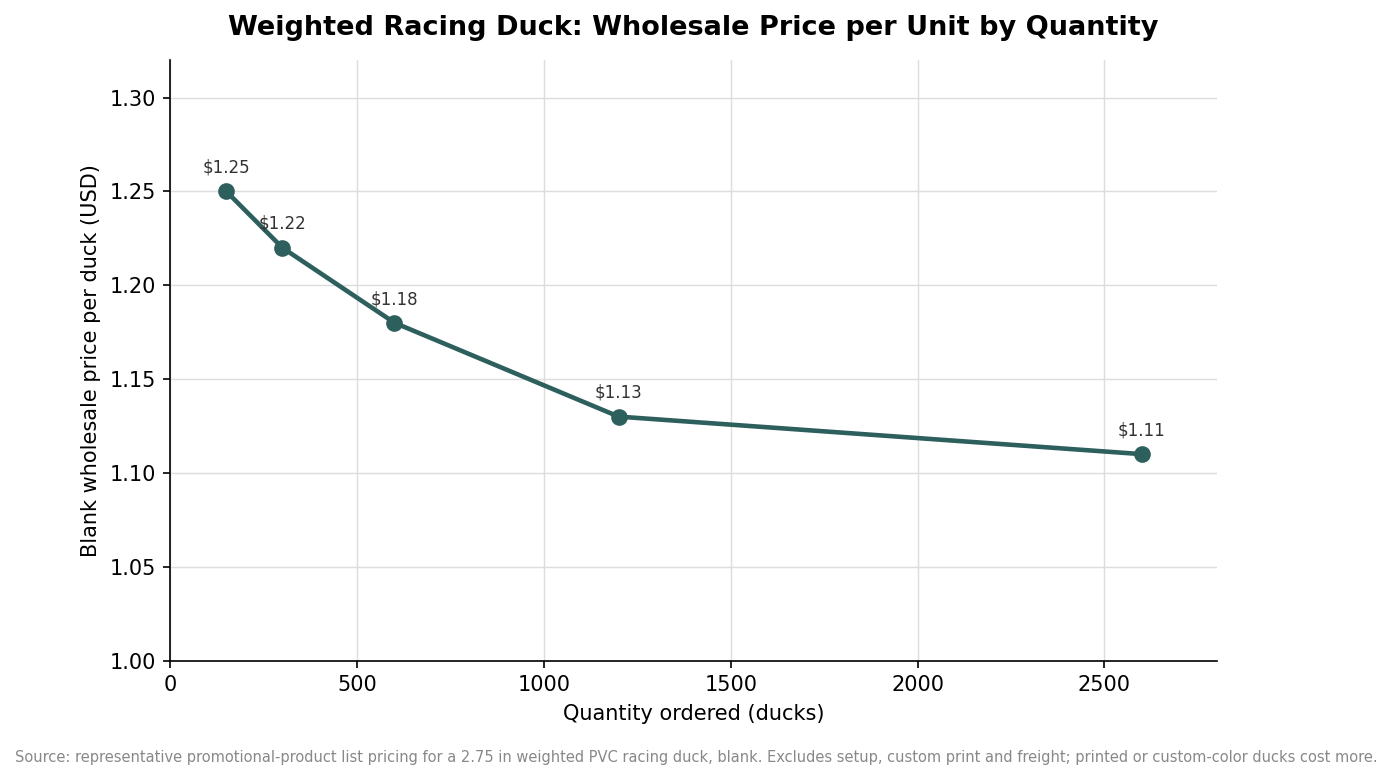
    Your cost depends on the duck style, the numbering and print, and the quantity. Plain weighted racing ducks are the most economical; adding your logo, a custom body color, or a printed sponsor mark adds to the price and the production time, and a fully custom mold is a separate, larger commitment. At Customized Rubber Ducks the minimum order is 12 ducks on stock bodies, with bulk tiers as quantities grow, and standard production ships in about 2 weeks after you approve your free mockup. If your race date is close, tell your supplier the date up front so express shipping can be arranged. Send your quantity and numbering needs for a free mockup and a quote before you lock your budget.

    Setting the adoption price and hitting the goal

    The order quantity and the adoption price are the same decision viewed from two sides. Your gross is simply adoptions multiplied by the adoption price, and your net is that gross minus the cost of the ducks, permits, insurance, and prizes. Divide your fundraising goal by the adoption price and you have the number of adoptions to sell, and therefore the minimum number of numbered ducks in the water. Raise the adoption price and you need fewer ducks and fewer sales to hit the same goal; lower it and you need more of both. Because the ducks are only one line in the budget, the adoption price is the lever that most determines whether the event clears its goal, so set it deliberately and size the duck order to match.

    Order identical weighted ducks, number them cleanly on the bottom, buy a little past your adoption target, and set the adoption price against a real fundraising goal. Those four choices, made before you place the order, are what separate a duck race that runs smoothly from one that does not.
  • Are Custom Rubber Ducks Safe? Materials, Phthalates, and Toy Standards

    Are Custom Rubber Ducks Safe? Materials, Phthalates, and Toy Standards

    The name is a small lie. A modern rubber duck is almost never made of rubber, and whether it is safe depends far less on the material’s reputation than on who the duck is actually for. A duck handed to a toddler in a bathtub and a duck clipped to a Jeep mirror are held to very different legal standards, even when they come off the same mold. If you are ordering custom ducks in bulk, the useful questions are what the toy is made of, which rules attach to it, and what to ask a supplier to prove. Here is how those three pieces fit together.

    What a rubber duck is actually made of

    Nearly all custom ducks are molded from polyvinyl chloride, or PVC, which on its own is a hard, brittle plastic. What makes a duck squeezable is a plasticizer, an additive that wedges between the polymer chains and lets them slide, and the choice of plasticizer is the whole safety story. For decades the standard softeners were phthalates, which are cheap and effective but have been linked to hormone disruption and reproductive harm, which is why regulators moved against them in children’s products. Today reputable manufacturers reach for phthalate-free alternatives instead, commonly DINCH, terephthalates such as DOTP, citrates, and adipates, which deliver similar flexibility without the restricted compounds. A smaller share of ducks are made from silicone or natural rubber for buyers who want to avoid PVC entirely, though those cost more and behave differently in the mold, holding finer detail in silicone but softening less predictably in natural rubber. When a supplier calls a duck “phthalate-free,” they are really telling you which plasticizer family they used, and that claim is worth getting in writing.

    The rules that apply if it is a toy

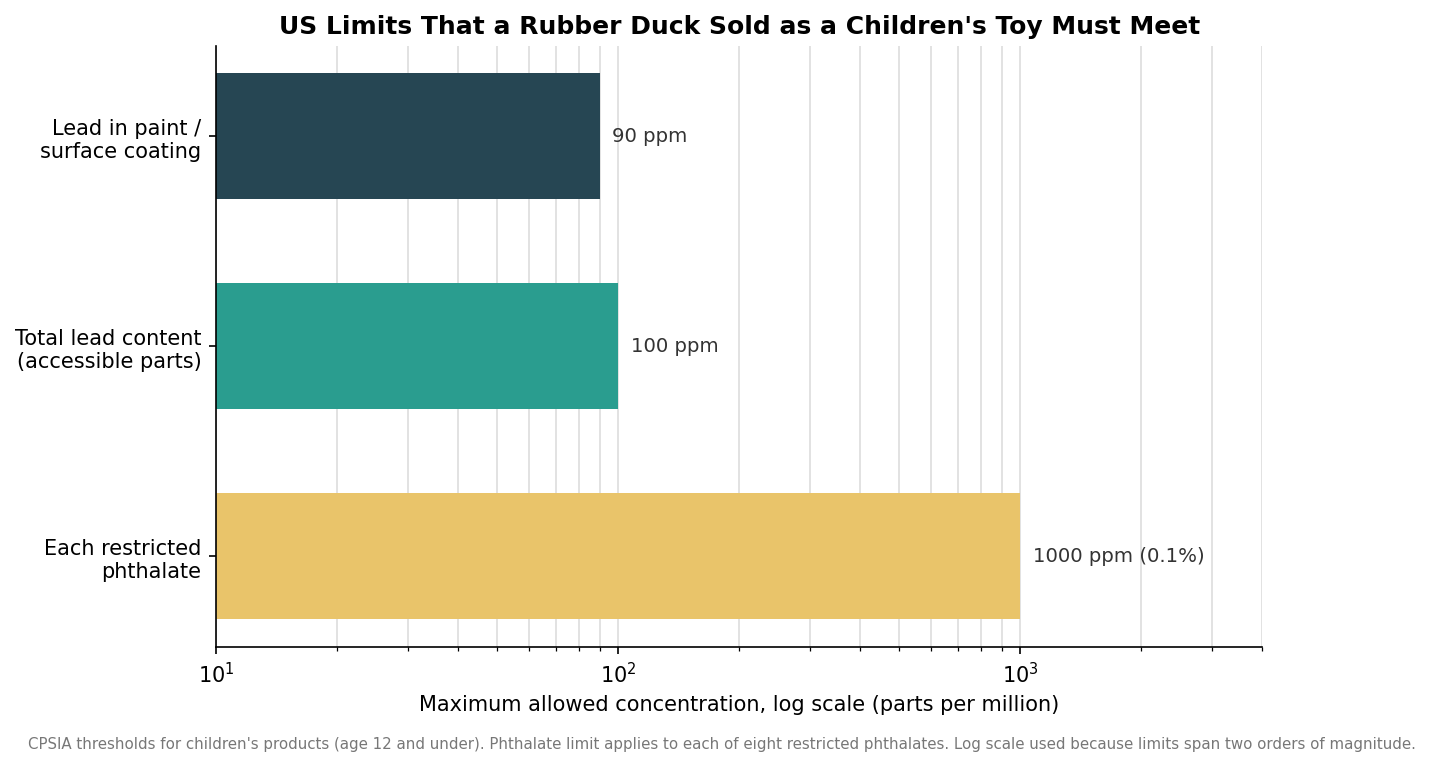
    Once a duck is designed, manufactured, or marketed as a plaything for children under 14, US law treats it as a toy, and a stack of requirements switches on. The Consumer Product Safety Improvement Act caps total lead at 100 parts per million in accessible parts and lead in any paint or surface coating at 90 parts per million. It also permanently restricts eight named phthalates, DEHP, DBP, BBP, DINP, DIBP, DPENP, DHEXP, and DCHP, to no more than 0.1 percent each in the plasticized components a child can reach.

    Horizontal log-scale bar chart of US CPSIA limits for a rubber duck toy: 90 ppm lead in coating, 100 ppm total lead, and 0.1 percent per restricted phthalate
    The CPSIA chemical limits a rubber duck sold as a children’s toy must meet.

    On top of the chemical limits sits ASTM F963, the federal toy safety standard. The current version, ASTM F963-23, was published in October 2023 and applies to toys manufactured on or after April 20, 2024. It goes well beyond chemistry to cover small parts and choking hazards, sound levels for squeakers, sharp points and edges, and labeling. Compliance is not a matter of a supplier’s word: a children’s product has to be tested by a CPSC-accepted third-party laboratory, and the importer or manufacturer then issues a Children’s Product Certificate documenting the passing results. A permanent tracking label on the product and packaging closes the loop so a specific batch can be traced later if a problem surfaces after it ships.

    Who the duck is for changes everything

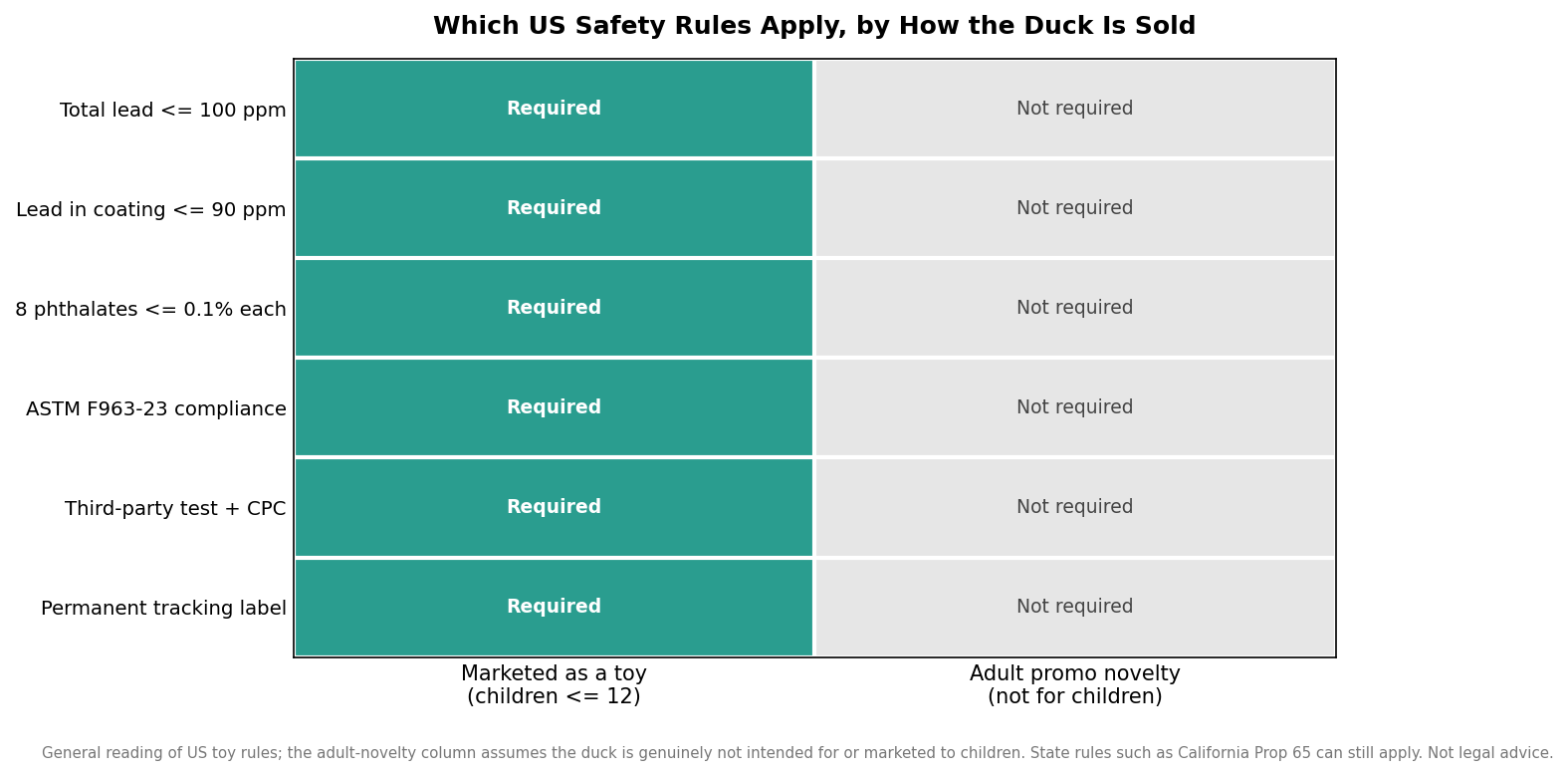
    This is where custom orders get interesting, because the same duck can sit in two entirely different regulatory buckets. A duck sold as a bath toy or a party favor for kids is a children’s product and carries the full weight above. A duck produced strictly as an adult promotional novelty, a trade-show giveaway, or a Jeep-ducking gift that is genuinely not intended for or marketed to children, is not a children’s product and does not trigger the toy-specific testing regime.

    Grid comparing which US safety requirements apply to a rubber duck marketed as a children's toy versus an adult promotional novelty
    How the duck is sold decides which safety requirements attach to it.

    The catch is that intent is judged by how the product is designed, packaged, and advertised, not by a disclaimer buried on a hangtag. A duck in bright primary colors, sized for small hands, and shown in bath imagery will be read as a toy no matter what the fine print says. If you are ordering novelty ducks for an adult audience, keep the marketing and packaging consistent with that intent, and if there is any real chance children will use them, order to the children’s standard from the start rather than betting on the label. State rules can also apply on their own track; California’s Proposition 65, for example, can require warnings regardless of the federal toy question.

    What to ask a supplier before you order

    A safe order comes down to documentation, not promises. If the ducks are for children, ask for the Children’s Product Certificate and the underlying third-party test report against ASTM F963-23, and confirm the total lead, coating lead, and phthalate results fall under the limits above. For sale into Europe, the equivalent framework is the EN71 series, with EN71-1 covering mechanical and physical properties, EN71-2 flammability, and EN71-3 the migration of certain elements, paired with CE marking. Regardless of destination, ask which plasticizer the factory uses and get the phthalate-free claim specified by name. It is also worth confirming the duck has a properly sealed or drainable body, since the same squeaker hole that makes a duck squeak is the path water takes inside, where it can sit and grow mildew, a durability issue distinct from chemical safety but one buyers feel just as keenly. None of this requires you to become a compliance expert. It requires you to ask for the certificate, read the numbers, and match the product you order to the people who will actually hold it.

  • Custom Jeep Ducks: How Ducking Works and What to Order

    Custom Jeep Ducks: How Ducking Works and What to Order

    If you have parked near a trailhead or a mall in the last few years, you have probably seen a little rubber duck perched on a Jeep dashboard. It looks like a small in-joke, but “Jeep ducking” has grown into one of the largest grassroots gifting habits in the car world, and it runs entirely on cheap rubber ducks that strangers leave for one another. For a business, a club, or a dealership, that makes a custom-printed duck an unusually effective calling card. This guide covers where the trend came from, the etiquette that keeps it fun, and how to spec and order ducks that fit the culture instead of fighting it.

    Where “duck duck jeep” came from

    The tradition started in 2020 with Allison Parliament, a Canadian then living in Alabama. During the early pandemic she bought a bag of rubber ducks and, after a rough day, left one on a stranger’s Jeep with a note that simply said “nice Jeep.” The owner asked her to share it online, and the idea spread fast. By 2022 the Jeep-ducking Facebook groups had swelled to roughly half a million members, and by 2023 a duck on the dash had become a common sight at Jeep meets and parking lots alike. Parliament, affectionately called the “Mother Ducker” by the community, passed away in June 2024, and the tradition has since taken on a memorial dimension for many participants. The point of the origin story for a buyer is simple: this is a kindness ritual, not an advertising channel, and ducks that respect that spirit travel much further.

    The unwritten rules that keep it fun

    Ducking has a light etiquette that regulars take seriously. You duck other people’s Jeeps, not your own — self-ducking is considered bad form because it misses the whole point of a surprise gift from a stranger. Most people tuck the duck by a door handle or wiper so it is found but not blown off on the highway, and many tag it with a small “you’ve been ducked” card. Photos get shared under the #DuckDuckJeep hashtag, which is where a lot of the community’s momentum lives. A custom duck earns goodwill when it feels like a gift first and a logo second; a duck that reads like a flyer glued to a windshield tends to get tossed. That distinction should shape every decision you make about artwork, tags, and quantity.

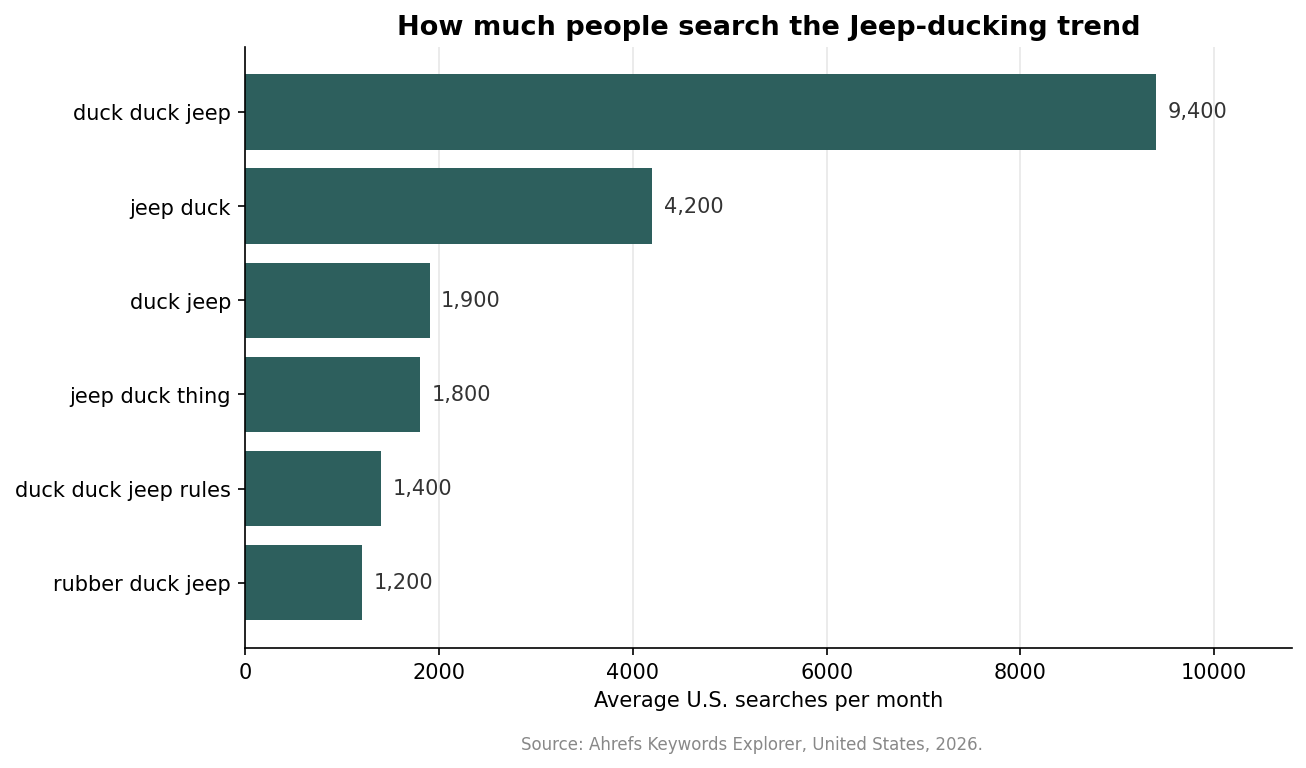
    Horizontal bar chart of average monthly US search volume for jeep ducking terms, led by duck duck jeep at 9,400
    Search demand around Jeep ducking is large and steady, led by ‘duck duck jeep’ at about 9,400 searches a month.

    What actually makes a good Jeep duck

    The workhorse of the whole trend is the standard two-inch rubber duck. It is small enough to sit unobtrusively on a dash or door handle, cheap enough to give away by the hundreds, and large enough to carry a readable one- or two-color print. Larger three- and four-inch ducks and tiny one-inch “mini” ducks both have a place, but the two-inch is the size the community is built around, and it is what most people expect to find. Because these ducks spend their lives on a sun-baked dashboard rather than in a bathtub, buoyancy barely matters, while UV and heat resistance do: a duck printed with durable ink on quality PVC keeps its color far longer than a bargain novelty duck that fades to a pale yellow in a season. If you want the artwork to survive, ask about the print method — pad printing and screen printing hold up well on the curved body, while cheap stickers peel in the heat.

    Ordering custom ducks in bulk

    There are two broad ways to get a branded duck. Printing your logo on a stock yellow duck is fast, inexpensive, and the right call for the vast majority of ducking programs. Commissioning a fully custom-molded duck — a new body shape or color — is a much bigger commitment, with tooling cost and extra production time on top. For most buyers the printed stock duck wins on every practical measure. At Customized Rubber Ducks the minimum order for printed ducks is 12, and the cost per duck falls as the run grows. Add-ons matter too: a “you’ve been ducked” hang tag, a QR code that points to your website or a community group, and polybagging all add a little cost but a lot of polish. Standard production for a printed order ships in about 2 weeks after you approve your free mockup, longer if you are commissioning tags or matching a specific Pantone color, so order well ahead of an event.

    Who orders them, and why it works

    The strongest programs come from businesses that already sit near the Jeep community. Dealerships hand ducks to buyers and leave them at meets; off-road and accessory shops slip them into orders; coffee stands, breweries, and local events use them as tiny, memorable giveaways. A QR-coded duck turns a roadside act of kindness into a soft introduction to your brand, and because the recipient chose to pick it up, the impression starts positive. The selection logic is straightforward: if your goal is pure community goodwill, keep the branding subtle and the tag warm; if you are running a measurable campaign, add a QR code and a short landing page so you can see what the ducks drive. Match the quantity to the plan — a single event might need 250, while an ongoing dealership program can run to the thousands. Get the size, the print durability, and the tag right, and a two-inch duck does something most promotional products never manage: it makes a stranger smile before they ever see your name.

  • Why Bath Ducks Go Moldy Inside

    Everyone who has squeezed an old bath duck and watched black specks come out has asked this. The answer is simple and slightly grim.

    What is happening

    A squeaking duck has a hole in its base. Under water, squeezing the duck expels air and then draws water back in through that hole.

    That water does not fully drain. It sits inside a warm, dark, enclosed space that never dries out, which is close to ideal conditions for mold. The black specks are mold colonies breaking loose.

    Why cleaning does not really solve it

    You can flush a duck with hot water and a little vinegar or bleach solution, squeeze it out and dry it hole-down, and that helps.

    But you cannot see inside, you cannot scrub inside, and the hole will let water back in the next time it is used. It is management rather than a fix.

    The actual fix

    A fully sealed duck with no hole at all. Nothing goes in, so nothing grows. It cannot squeak and it cannot squirt, and that is the entire trade.

    For any shared setting — a pool, a nursery, a clinic play area — sealed is usually the only answer that survives an infection-control conversation.

    If you must have the squeak

    Buy sealed for the shared settings and squeaking for home, rinse and dry hole-down after use, and replace them rather than keeping them for years.

    And plug the hole with a dab of hot glue if you want to keep a favourite duck — it kills the squeak and stops the problem.

  • The Complete Buyer’s Guide to Custom Rubber Ducks

    Ducks look like the simplest thing you will ever order. Four questions separate a good order from an expensive one.

    Treat it as a toy, because it will be treated as one

    If a child can reach it, it needs toy safety testing: phthalates in the vinyl, heavy metals in the paint, small parts, and an age grading.

    Ask for current test reports with the quote. A supplier who has them will send them without fuss; one who has to go and find out is telling you something.

    Decide whether it squeaks, knowing what that means

    A squeak needs a hole. The hole lets bathwater in when the duck is squeezed, and that water stays inside and grows mold.

    A sealed duck cannot take water in and cannot squeak. Pools, nurseries and clinics should buy sealed almost every time. A bath toy for home use is a genuine choice.

    Do the tooling arithmetic before falling in love with a shape

    A custom mold is a real one-off cost. Ask for it as a separate line, then divide it by your run size.

    Below the crossover, a printed and dressed stock body gets you most of the way for a fraction of the money. Above it — or if you will reorder, since the tool is held — the mold wins.

    Check that the print is made for water

    A logo that comes off in the bath is worse than no logo, because the thing that failed is carrying your name.

    And artwork needs redrawing for a small curved surface: fine detail and small type distort badly on a duck.

    What to send when you ask for a quote

    Artwork, quantity, and where the ducks will be used — bath, pool, river race, shop shelf. That last answer changes the body, the hole and the colour.

  • Custom Mold or Printed Stock Duck?

    Almost everybody who asks for a custom duck means a duck that looks custom. Those are different products with very different price tags.

    What a custom mold actually buys

    A silhouette nobody else has: a mascot’s body shape, a helmet, a posture, a character that is recognisably yours from across a room.

    It needs its own steel tool, which is cut, sampled and approved before any production runs. That is a real one-off cost and a real lead time.

    What a dressed stock body buys

    A stock duck with printing, colour, a costume, a hat or molded accessories. From two metres away most people cannot tell the difference, and it carries no tooling cost at all.

    On a run of a few thousand, the money saved usually exceeds the entire rest of the budget.

    Where the crossover sits

    Divide the tooling cost by your run size and add it to the unit price. That single calculation answers it.

    And remember the tool is held for reorders, so an annual event that will run for five years should do the sum across five years rather than one.

    The safety footnote on accessories

    Anything applied to a duck for a child is a small-parts question. Hats, glasses and props must be molded in or fixed so they cannot be pulled off.

    If a supplier is glueing accessories onto a toy for under-threes, that is the end of the conversation.